How to check forward head posture at home
Check forward head posture at home with one photo from the side: stand the way you normally stand, have someone shoot you side-on from about chest height, and look at whether your ear sits over your shoulder or ahead of it. A mirror answers the same question in a rougher way — stand side-on to it and glance across.
The LOOKSMAXBRO posture check reads that photo for you. It finds the ear and the shoulder on the side facing the camera, draws the line between them and the horizontal through the shoulder, and prints the angle between the two — an estimate of the craniovertebral angle, the measurement used for this in a clinic. The landmark model runs inside this tab, so the photo stays on your device.
What makes a photo it can read
- Side on, not three-quarters: one shoulder toward the lens.
- Whole body in the frame, head to hips — the torso is what the second number is measured against.
- Arms down, weight on both feet, standing the way you actually stand. A photo of your best posture measures your best posture.
- Hair tucked behind the ear, collar down, and a plain wall behind you if there is one.
- Camera about chest height and a few steps back, held level.
How to read your craniovertebral angle
Your craniovertebral angle is the angle between the horizontal and the line running from your shoulder up to your ear, and about 50° or more is where most upright adults sit. Bigger is more upright: 90° would be an ear directly above the shoulder.
- 50° and up In range
The ear sits over the shoulder or close to it. Worth re-shooting in a month to make sure a desk or a phone habit is not walking it forward.
- 45–50° Mild forward head
The head is a little ahead of the shoulders — the usual reading after years of screens. This is the band that responds fastest to chin tucks and a screen raised to eye level.
- Under 45° Forward head posture
The head is carried well forward of the shoulders. Nothing here is urgent by itself, but it is the band worth training deliberately — and worth a physical therapist if it comes with neck pain, numbness or headaches.
The second dial says the same thing in a different unit: how far ahead of the shoulder the ear sits, as a percentage of your own torso height. Because it is scaled to your torso, it can be compared between photos taken from different distances — which the raw pixels cannot.
Read the band, not the decimal. This is an estimate: a clinician measures from the C7 vertebra at the base of the neck, a photograph does not contain C7, so the shoulder stands in for it, and the reading moves with how you were standing, where the camera was and how the model placed the points. Shoot the same way each month and a change of a few degrees means something. One number on its own does not, and none of it is a diagnosis.
How to fix forward head posture: the exercises that move it
Forward head posture is fixed with a few minutes a day of chin tucks, wall neck holds and shoulder-blade work — not with a brace, which does the holding for you and teaches your neck nothing.
It is a habit and a muscle pattern rather than a change in the bones, which is why it answers to training, and why raising the screen you look at all day does as much as any exercise. Grades below are the evidence grades from the LOOKSMAXBRO habit catalog, in the catalog’s own words.
- Chin tucks and neck retraction moderate
Sliding the head back over the shoulders, held for a few seconds, ten or so times a day. It is the move the studied neck programs are built around, and the one FaceMax A holds at the wall.
- Wall neck holds moderate
Back of the head against a wall, chin level, holding the position the exercise is trying to teach. Cheap, boring, and the fastest way to notice how far forward the head has been sitting.
- Shoulder-blade and upper-back work moderate
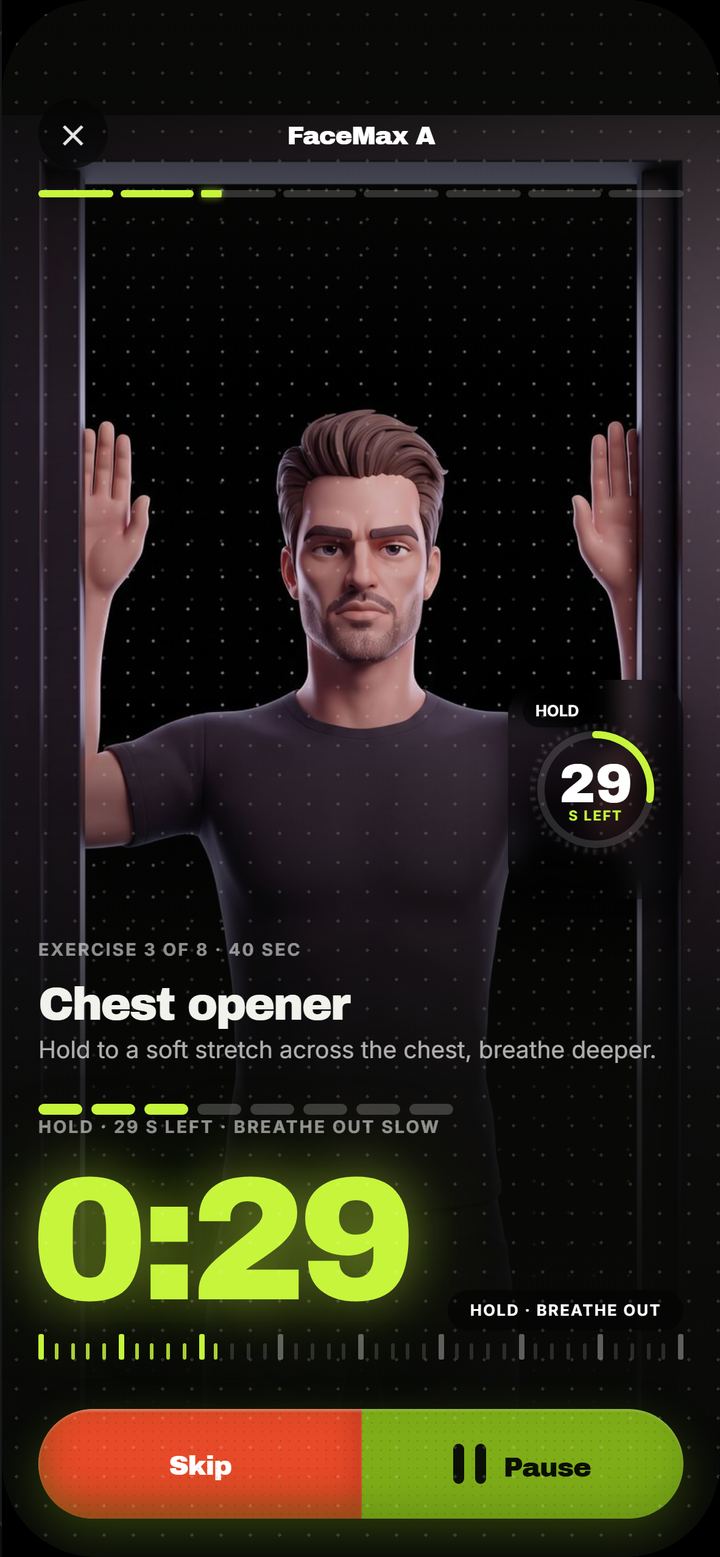
Rows, band pull-aparts, chest openers. The head cannot sit back over shoulders that are rolled forward, which is why the posture lesson trains both ends.
- Screen height, and standing up every hour moderate
A monitor at eye level and a phone lifted rather than looked down at remove the reason the head goes forward in the first place. The exercises fight the desk; this one changes it.
- Posture braces and “posture correctors”
A brace holds your shoulders where it wants them for as long as you wear it, and the muscles that have to hold that position learn nothing meanwhile. Useful as a reminder at most.
- Surgery for a “neck hump”, and anything sold as moving bone out of scope
Out of scope here. LOOKSMAXBRO trains muscles and habits; a fatty or bony hump at the base of the neck is a question for a doctor, not for an app or a browser tool.
A head carried forward also shortens the line under the jaw, which is why the neck moves inside FaceMax A sit on the same day plan as the posture lesson — and why the jawline usually looks different in a side photo long before anything about the face has changed.