The lesson, move by move
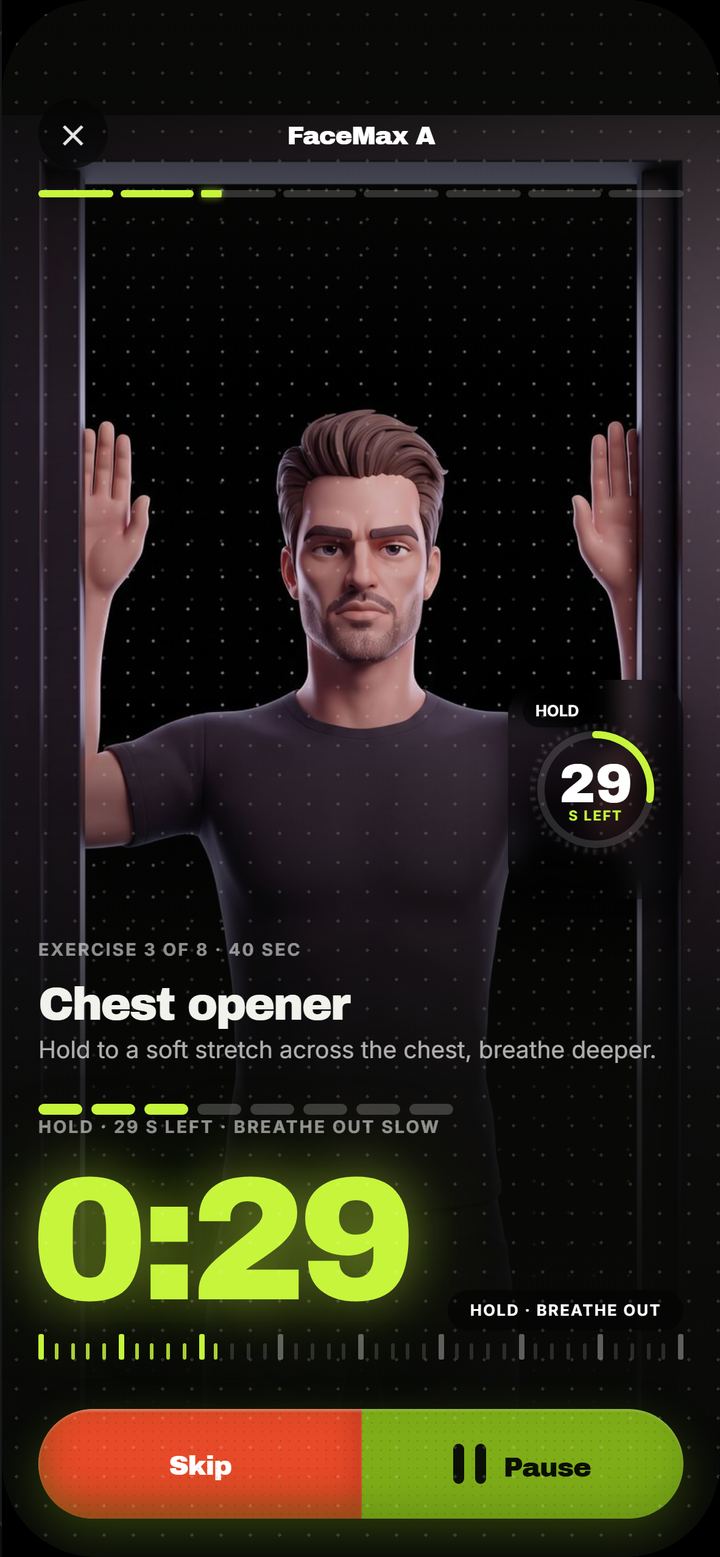
That is one pass through the block, and the order is the app’s own argument. It opens with the two moves that play here: Slow nod wakes the top of the neck, then Shoulder rolls open what has been closing all day, because a neck set on top of rounded shoulders has nothing to hold on to. The six that stay in the app carry on through the same half — the chest, the shoulder blades, the front of the neck and then the side of it — and close with two moves for the face. Six of the eight are posture work and two are the face; three of them want a wall or a doorframe, and the rest need nothing but a floor to stand on.
What the lesson trains, and do neck exercises work
Neck exercises work on where your head is carried and on nothing else: the muscles at the front of the neck that hold a chin tuck, the ones between the shoulder blades that stop the shoulders rolling in, and the chest that pulls them there in the first place. What they do not touch is the bone, the fat under the chin or the width of the jaw — and this lesson claims none of it.
A neck that reads as set is four things stacked on each other: where the head is carried, how open the chest and shoulders are, how much fluid the tissue is holding that day, and the skeleton under all of it. Exercise moves the first two and moves them slowly — the neck programs that have been studied run four to eight weeks before the angle shifts by a few degrees.
Here is everything that moves the angle your head sits at — this lesson’s own work first — each row carrying the grade the LOOKSMAXBRO habit catalog gives it.
- Posture drills — the wall check, the chin tucks, the shoulder blades moderate Six of the eight moves are this, and it is the best-graded work in the lesson: LOOKSMAXBRO grades posture drills B, which this page prints as moderate. The dose the catalog asks for is small — a two-minute wall check and ten chin tucks a day — and four to eight weeks is when the angle starts to read differently.
- A screen at eye level, and a few standing breaks a day moderate The desk fix and the neck-and-shoulder breaks are graded B as well, and they are the only rows here that remove the cause instead of training against it. The break itself is tiny and the catalog asks for a few of them a day — stand up, roll the shoulders, tuck the chin, three times over is where it starts you. Seven minutes of exercise against eight hours of looking down is an argument the desk usually wins.
- The two face moves — the brow line and the chewing muscle weak Face-muscle work is C in the catalog, which this page prints as weak, and it is the row the app files FaceMax A under. The last two moves of the block let go of a clench you have been holding since the morning, at the brow line and at the jaw angle; neither of them builds a jawline, and the six moves before them do more for how one reads.
- Strength training — the gym, not this lesson strong The one A on this page belongs to the gym rather than to anything in the neck zone: shoulders, a back and a trunk trained under load change a silhouette far more than a few minutes of mobility ever will. The bodyweight version at home is graded B, which is enough to start with, and the gap between the two is worth knowing.
- Posture braces and “posture correctors” A strap can remind you that you have slumped again; it cannot teach the muscles at the front of your neck to hold your head there once it comes off, and that holding is the entire skill this lesson is training. There is no habit for a corrector in the LOOKSMAXBRO catalog, so this row has no grade to borrow while every exercise row above has one.
- Cracking your own neck, and pulling the stretch harder A fast twist is not a mobility drill, and the catalog has no habit for one. Every stretch in this lesson is held under its own weight rather than pulled — the app’s instruction is no pulling, and it is an instruction rather than a suggestion, because the range you can force is not range you keep.
- Surgery, injections and fat removal for a neck hump out of scope Out of scope on this site and in the app. LOOKSMAXBRO trains muscles and habits; a lump where the neck meets the upper back that is firm, growing or painful belongs to a clinician, and nothing in a seven-minute lesson is an answer to it.
Every grade here is the app’s own, out of the habit catalog LOOKSMAXBRO builds its day plans from, so nothing on this page promises more than the evidence behind it, and a row with no chip beside it is one the catalog grades nothing at all. Surgery, injections and fillers are out of scope: LOOKSMAXBRO does not advise on them here or in the app.
Neck mobility exercises, stretches, and the desk that undoes them
Neck mobility exercises and neck stretches are two different jobs, and FaceMax A does both. Slow nod, the move that opens the lesson and one of the two that play here, gives the top of the neck its range back at the base of the skull — eleven small nods and nothing bigger. The block goes on in the app to lengthen the side of the neck, and then to hold — and a hold is neither of the two: it teaches the front of the neck to keep the head where the mobility work just put it, which is the part a stretch on its own never delivers.
Stretching alone is why most neck routines quietly stop working. A stretch buys range for an hour; the reason your head drifts forward again is eight hours in front of a screen set below your eyes. Raise the monitor, lift the phone instead of dropping your chin to it, and stand up a few times a day — the catalog asks for three of those breaks and grades them and the desk fix B apiece, the same moderate as the exercises, and they are the half that keeps the day from undoing the lesson.
Most of this works at a desk. Slow nod and Shoulder rolls — the two that play here — need no wall and no equipment, and together they take a minute and a quarter. Three of the six behind them do need something, a doorframe or a wall to stand against, and they are worth waiting for a wall for, because the wall is the only thing in the room that can tell you whether you tucked your chin or just tipped your head back.
Everything else in this zone — what a neck hump actually is, whether a pillow can fix anything, why a head carried forward makes the same jaw read softer — is collected on the LOOKSMAXBRO neck page.
How often to do neck exercises, and how long until results
Neck exercises can be done most days: this is mobility and light holds, not heavy training, so there is no rest day to respect. The LOOKSMAXBRO plan schedules the FaceMax A block every other day and puts the posture drill itself — the two-minute wall check and the ten chin tucks — on the daily plan alongside it, so the habit runs more often than the lesson does. FaceMax A’s own briefing in the app says eight moves, any time of day; the app still nudges FaceMax towards the morning, between 8:00 and 13:00, and counts the session whenever you actually do it.
How long until results: four to eight weeks of near-daily work before the angle your head sits at moves by a few degrees. That is what the studied neck programs report, and it is why the catalog grades this work moderate rather than strong. Two things change sooner and are usually mistaken for the exercises working — the tightness across the chest and the top of the neck, which tends to ease inside a week or two, and how you look in a photo the moment you stand tall, which is the same neck presented differently rather than a new one. Re-shoot the same side photo every four weeks with the free posture check if you want the angle instead of the impression.
Stop for the day at anything sharp, and stop straight away at dizziness — the nods are small, every stretch in the block is held rather than pulled, and the app’s own rule before the first session is that nothing here should hurt. Neck exercises are not treatment and this page diagnoses nothing: a recent neck injury, pain or numbness running into an arm, or headaches that arrive with the movement are a question for a clinician first and a lesson second.
Neck and posture words, defined
- Acute infection or fever
- Skin inflammation on the face or neck
- Thrombosis, heart failure
- Cancer, diagnosed lymphedema
- A recent neck injury or whiplash, or a neck problem you are under a clinician’s care for
- Numbness, tingling or weakness running into an arm or a hand
Dizziness, sharp pain or a click in the joint — stop. Nothing here should hurt. Dizziness during a neck movement means stop for the day rather than push through, and pain, numbness or headaches that arrive with the movement are a reason to see a clinician before you carry on. Nothing on this page is a diagnosis.